


Install Steam
sign in
|
language
简体中文 (Simplified Chinese)
繁體中文 (Traditional Chinese)
日本語 (Japanese)
한국어 (Korean)
ไทย (Thai)
Bahasa Indonesia (Indonesian)
Bahasa Melayu (Malay) BETA
Български (Bulgarian)
Čeština (Czech)
Dansk (Danish)
Deutsch (German)
Español - España (Spanish - Spain)
Español - Latinoamérica (Spanish - Latin America)
Ελληνικά (Greek)
Français (French)
Italiano (Italian)
Magyar (Hungarian)
Nederlands (Dutch)
Norsk (Norwegian)
Polski (Polish)
Português (Portuguese - Portugal)
Português - Brasil (Portuguese - Brazil)
Română (Romanian)
Русский (Russian)
Suomi (Finnish)
Svenska (Swedish)
Türkçe (Turkish)
Tiếng Việt (Vietnamese)
Українська (Ukrainian)
Report a translation problem


 Terrains in games usually work with grayscale textures. Each pixel represents a certain height within a specified range. A value of 0 means no deformation; a value of 0.5, say, pushes the terrain up by 5 meters.
  The Stamps in their identity are basically the same as Baseplates, but just a bit smaller in dimension.
 The more interesting are the following; I want to explain a bit further.
 Also, with the new system, the surface type (screenshot bottom right) gets correctly assigned now. Every terrain layer comes with a type, and when the terrain is generated, each tile's surface type gets derived from the terrain layer.
 The new system also gives us more control over how objects get rendered on screen, and it improves performance significantly. Especially on low-spec PCs, the gain is noticeable: in our measurements, we saw a performance gain of up to 250% in certain areas.


 TCR Impetus Personnel Roster
  21
21
 MENACE In-Depth Perks/Talents Guide

 Major FUBAR Guide
 Useful unexplained mechanics
 Award
Award










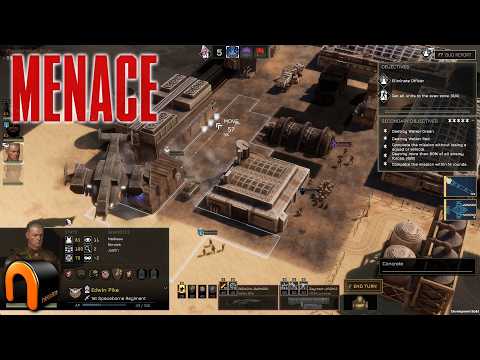





 Some builds // Некоторые билды
 Loading

